
How To Taste
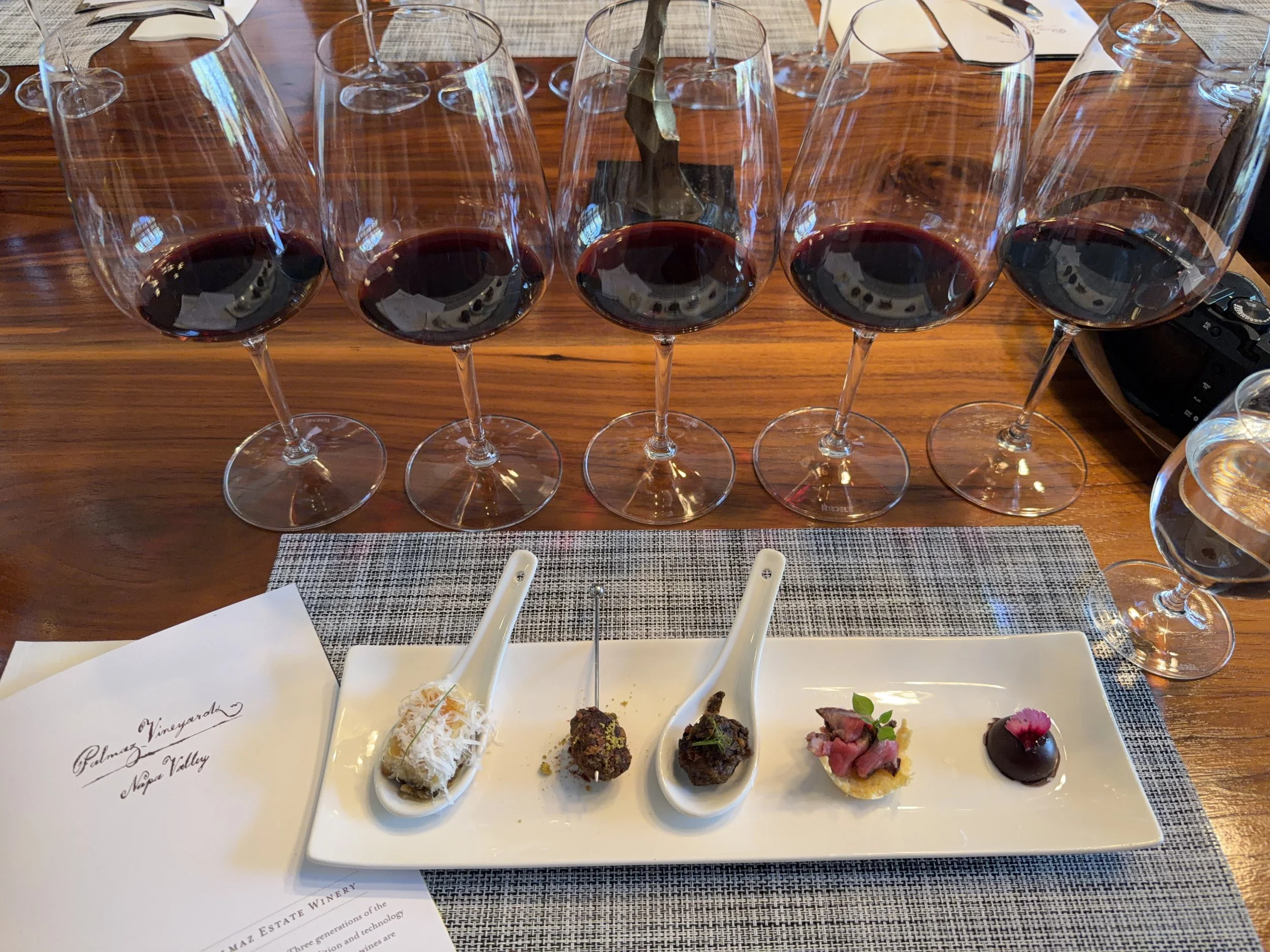
Vertical tasting at Palmaz Vineyards in Napa Valley.
This is a foundation piece, and it’s meant to be a companion to me attending the CMS deductive tasting workshop. Think of it as the quick, down and dirty breakdown of how to taste (and somewhat elevate) wine. It’s a non pretentious guide, and I’m hoping it can score you some points at your next wine tasting, dinner, or winery visit. My goal is to give you the short but approachable guide I wish I’d had. Give it a quick read on your way to a winery and give it a go.
Why worry about the taste?
It’s to help discern quality of wine and judge its characteristics. It’s not about making up tasting notes. It’s meant to be helpful so people can navigate a complex industry. There is certainly some salesmanship involved, and there are qualities found within the traditional examples of certain wines and regions. These do shift a bit over time on a macro scale, but they’re what help the experts figure out specifics on region, variety, type, and producer.
Everyone’s palate is a bit different. There’s a small minority of super tasters, and everything else is learned through repetition and meaningful study of the industry. I’ll go over some of the big qualities that help differentiate wine below, along with some of the big terms that get used.
The Four S Method
I like to use the four S model: See, Smell, Sip, Savor. It’s the most straightforward, it’s fun, and it’s easy to expand on if you want to get more technical.
See: This is all about what’s appearing in the glass. The color, rim variation, viscosity, brightness, and clarity, among other things. At a basic level, the color of the core and rim and the clarity are going to tell me the most. The rest will help you get technical, along with the deeper sections when it comes to classifying wine. A lot of people like to look at the legs and make assumptions about the tannins. I don’t place too much stock in this, other than if the legs have a stain or tint to them. The appearance of legs can vary a lot based on how much rinse aid or sanitizer was used on the glass.
Smell: This is the most important step, and the aromas make up about 80% of what you’re going to get from the wine. The aromas absolutely impact the taste, so it’s important to set yourself up for success here. I always take a nice sniff BEFORE I swirl, because there are some aromas that aren’t quite awake in the glass yet. After a good sniff or two, I’ll give it a good swirl. You get bonus points for making it look effortless. Even more bonus points if you close your eyes, though that isn’t always required. Some wines are single dimensional and have only one fruit. Others have multiple fruits, a mineral quality, or non fruit characteristics. I like to shoot for three fruits and two non fruits, along with the fruit condition: is it tart or ripe, jammy or stewed? Not every wine is going to hit all of this, and that’s okay if you or the wine falls short. Smell can also dial you in to the level of alcohol present, as well as some of the techniques the winemaker used. Malolactic fermentation, anyone? Another helpful shorthand is FEW: Fruit, Earth, Wood. Look for the normal fruits, then move on to earth (clay, limestone, leaves, mushrooms), and finish with wood: is oak influencing the wine with baking spices, herbs, sweet aromas, and so on?
Sip: I’m not blessed enough to be a super taster. I’ve been called a “flavor chaser” for my preference for sour beers, bitter cocktails, and a regular consumption of chartreuse, which is why I lean so heavily on the smell, or “nose.” The taste is important to confirm or deny the aromas you smelled. Sometimes what smells like ripe or jammy fruit tastes tart on the palate. That usually points to a cooler climate, whereas a wine that’s tart on the nose but ripe on the palate could mean something from a warmer climate. I take a small sip first, enough to coat my palate, and spit. I may have an initial impression, but I wait to confirm it with a second sip. This makes sure I’m “charged” and have enough to work out what’s going on with the taste and structure. I’m confirming the alcohol level after evaluating the nose and possibly the legs, and I’m looking at tannins, specifically how bitter the wine is (think about chewing on a tea bag). I’m also thinking about sweetness. The best way to evaluate and dial in the sweetness level is to take a tiny sip on the tip of your tongue. This keeps me from getting fooled by acidity or alcohol influencing my sense of the sweetness.
Savor: The best part. You’re enjoying the wine. Hopefully you’ve picked out some things you liked about it, and you’re taking in the finish, aka how long it sticks around with you. You can gloss over all the other steps you just did, or you can carefully evaluate each part to figure out how you might want to pair it with food. Either way, it’s about your own enjoyment and what you get out of the wine. Everyone enjoys coffee and tea differently, so why should wine be any different?
What’s the deal with spitting?
It’s important to spit so you can keep a straight head and stay focused. Tasting is work, which is why spitting is standard practice at a large tasting or conference, when meeting with distributors, and even when you’re visiting wineries. It matters even more when you’re comparing a dozen wines or spirits. It’s how my CIA cohort was able to sample and compare over 60 spirits during our residency in Napa this past May.
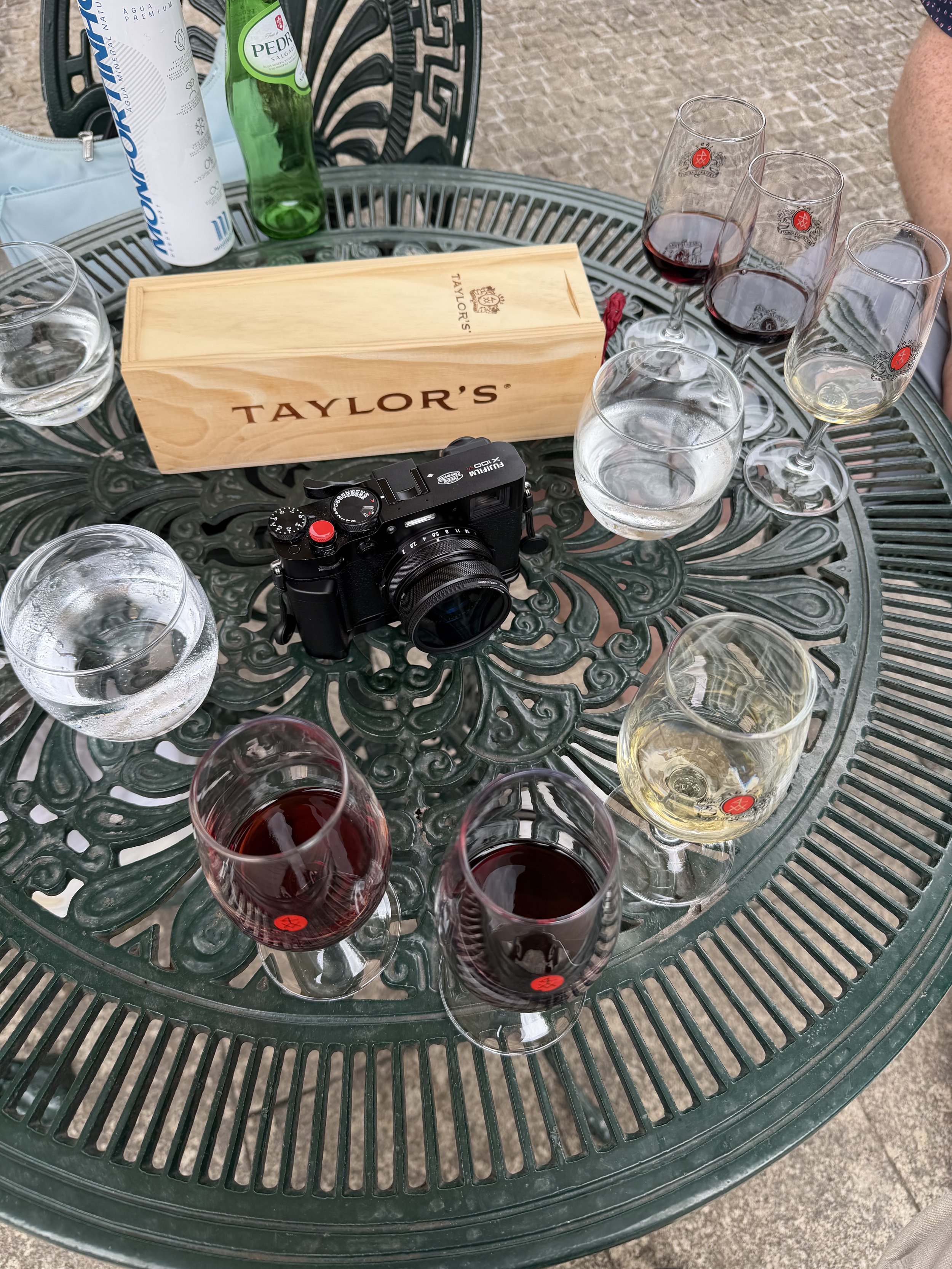
Port tasting at Taylor’s in Villa Nova de Gaia, Portugal.
A quick tasting glossary
Since I’m studying toward my CMS certification, I want to default back to their language here. First, the basic building blocks you’ll hear thrown around at any tasting, then the bigger picture terms for how tastings themselves get structured.
Acidity: The tartness or crispness in a wine, the thing that makes your mouth water and gives a wine its sense of freshness. Tasters usually score it Low, Medium-, Medium, Medium+, or High. Too little and a wine feels flabby. Too much and it tastes sharp or sour.
Tannin: The drying, grippy sensation you get mostly from red wines, from grape skins, seeds, and sometimes oak. Think about chewing on a tea bag, that’s tannin. Scored on the same Low to High scale as acidity, and it’s a big part of what lets certain reds age for decades.
Alcohol: You can sense alcohol as a warming sensation in the back of your throat and chest, sometimes even as a faint burn. It also affects body, since higher alcohol wines tend to feel fuller and rounder in the mouth. Scored Low through High just like acidity and tannin.
Sweetness: How much residual sugar is left in the wine after fermentation. The standard scale runs Bone Dry, Dry, Off Dry, Sweet, and Very Sweet. Worth remembering that a wine can smell fruity and still be bone dry. Fruit and sugar are not the same thing, which trips a lot of people up.
Body: How heavy or light a wine feels in your mouth, often compared to skim milk (light), whole milk (medium), and cream (full). Alcohol, sugar, and extract all push body upward.
Finish (or length): How long the flavors and sensations stick around after you swallow or spit. Scored Short, Medium-, Medium, Medium+, or Long. Generally, the longer and more pleasant the finish, the higher quality the wine, though this isn’t an absolute rule.
Balance: Whether any one element, acidity, tannin, alcohol, sweetness, fruit, dominates the others or if they all sit together comfortably. A wine can be technically well made and still feel out of balance if one piece is shouting over the rest.
Structure: The combined framework of acidity, tannin, and alcohol that holds a wine together, especially over time. When someone says a wine “has good structure,” they usually mean it has the acid and tannin to age gracefully, not just taste good tonight.
Deductive tasting: The method taught by the Court of Master Sommeliers, where you work through a wine’s appearance, nose, and palate in a set order to build toward a conclusion about grape, origin, climate, and vintage. It moves through Appearance (clarity, color, viscosity), Nose (fruit, earth, wood, intensity, and any faults), and Palate (flavor, structure, balance, length), before landing on an Initial Conclusion (climate, likely grape and country) and, eventually, a Final Conclusion. It’s a formal, methodical version of the Four S approach above, and it’s the backbone of what I practiced at the workshop.
Old World vs. New World: Old World traditionally means Europe, the classic wine producing regions like France, Italy, Spain, and Germany. New World traditionally covers everywhere else that grew out of that tradition, including the US, Argentina, Australia, South Africa, and New Zealand. You’ll still hear this constantly, but the framing is thankfully getting phased out. WSET dropped it back in 2022, and CMS Americas followed in late 2023, citing historical accuracy and cultural bias as the reasons. It’s a fair point. Countries labeled “New World” often have genuinely ancient winemaking histories (China has made wine for thousands of years, and Argentina has heritage vines planted in the 1850s), and the binary quietly implies Old World means authentic while New World means imitation. Neither is true. I’m thankful for this change.
Vertical tasting: Tasting multiple vintages of the same wine from the same producer side by side, say a Napa Cabernet from 2018, 2019, and 2020. It isolates the vintage as the variable, so you can taste how growing conditions and winemaking choices shifted year to year. Read more on what a vertical tasting is here.
Horizontal tasting: The opposite approach. You hold the vintage constant and taste the same variety or style from different producers, say a handful of 2021 Willamette Valley Pinot Noirs. This isolates producer and site as the variable instead.
Comparative tasting: A broader term for tasting wines side by side specifically to compare them against each other rather than evaluating each one in isolation. Vertical and horizontal tastings are both types of comparative tasting.
Blind tasting: Tasting a wine without seeing the label or bottle, so price, reputation, or region don’t color your judgment. Double blind tasting takes it a step further: neither the taster nor the person pouring knows what’s in the glass. This is essentially what the CMS deductive method is built for.
Flight: A small curated set of wines poured together for a tasting, usually three to six glasses. Verticals and horizontals are both usually served as a flight.
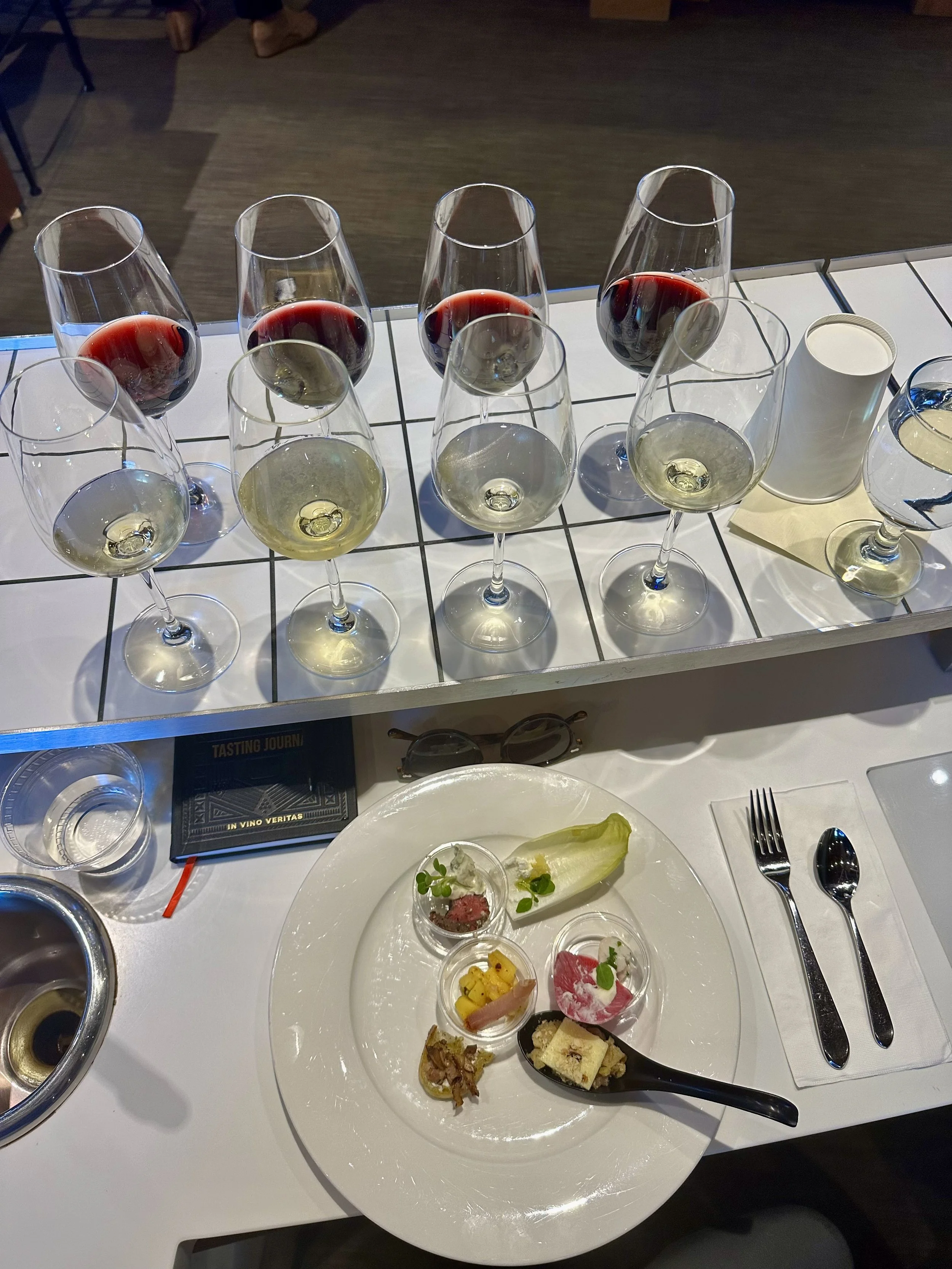
Food pairing tasting at Culinary Institute of America Greystone in Napa Valley.
Common myths
Good legs mean a good wine. The legs (or “tears”) running down the inside of the glass mostly tell you about alcohol and sugar content, not quality. A high alcohol wine will show more pronounced legs regardless of how good or bad it actually is.
Wine needs to breathe for hours before it’s ready. Most wines open up plenty within 15 to 30 minutes of being poured, and a good swirl in the glass does more in a minute than an hour of sitting corked on the counter. A handful of young, structured reds genuinely benefit from a longer decant, but it’s the exception, not the rule.
A screw cap means a cheap wine. Screw caps are a closure choice, not a quality signal. They’re standard on plenty of excellent bottles, especially out of Australia and New Zealand, and they actually cause fewer wine faults than cork.
Smelling the cork tells you something about the wine. It mostly tells you the cork didn’t fall apart. If you want to check for a fault, smell the wine itself. A corked wine (tainted by TCA) smells like wet cardboard or a damp basement, and you’ll pick that up from the glass far more reliably than from the cork.
Supertasters have the best palates for wine. It sounds like it should be true, but supertasters (people with a denser concentration of taste buds, somewhere around 25 to 30% of people) often find tannin and acidity more harsh and bitter than the rest of us do. A lot of great tasters are simply well trained, not biologically gifted.
More expensive always means better tasting. Price reflects land, labor, scarcity, and brand as much as it reflects what’s in the glass. Plenty of blind tastings, going back to the famous one below, have shown professional tasters rank cheaper bottles above expensive ones when they can’t see the label.
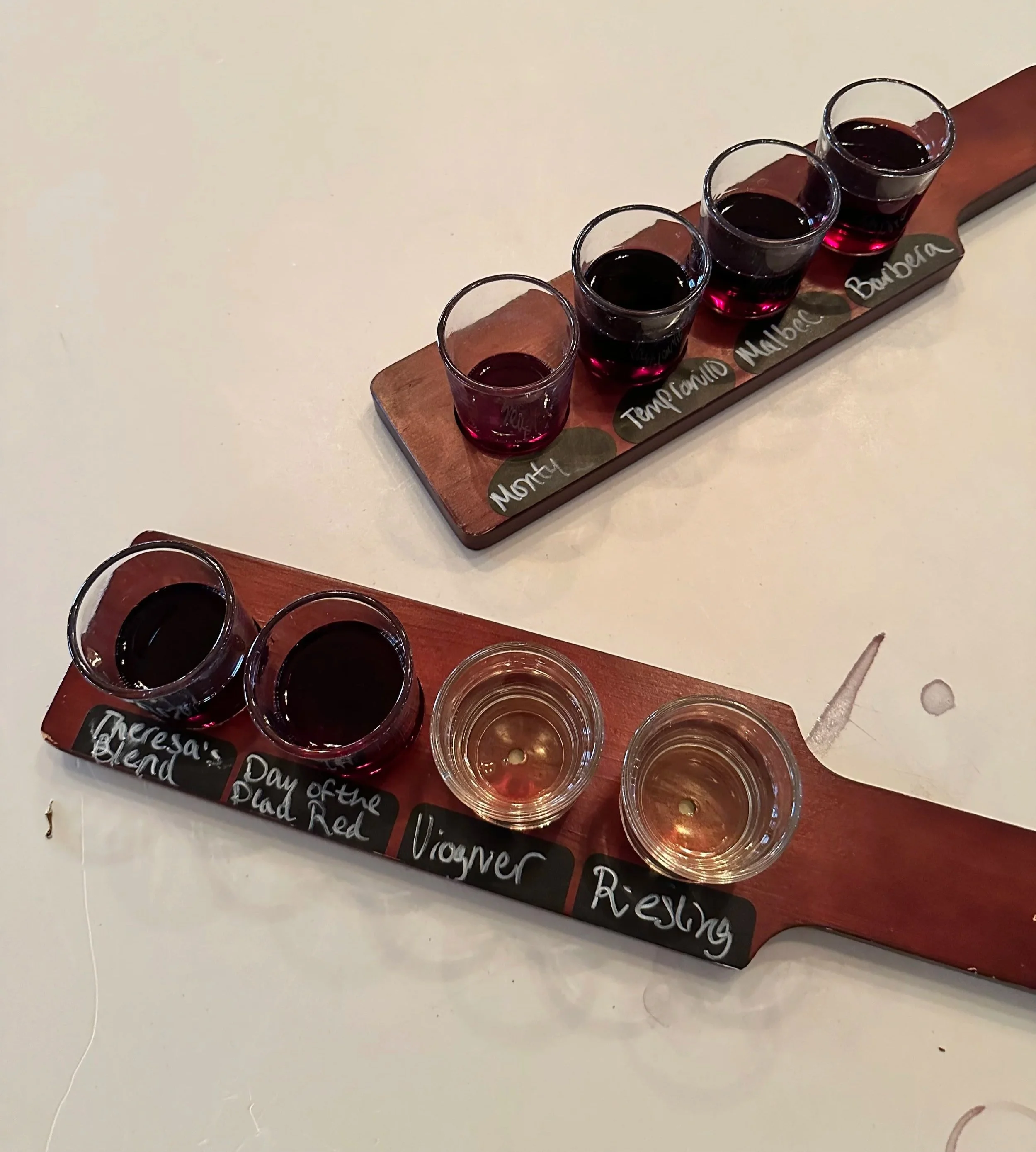
A flight of wines in Mesilla Valley, New Mexico.
Fun Facts
The human nose can distinguish over a trillion different odors, at least according to a widely cited 2014 Rockefeller University study. Contested exact number aside, the point stands: smell, not the tongue, is doing most of the heavy lifting when you taste a wine.
Depending on who you ask, somewhere between 80 and 95% of what you perceive as “flavor” is actually your sense of smell. What your tongue picks up on its own is really just sweet, sour, bitter, salty, and umami. Everything else, cherry, leather, wet stone, is your nose working overtime, including on the way back up through your throat after you swallow (that’s called retronasal olfaction, and it’s a big reason spitting at a tasting doesn’t cost you).
The most famous blind tasting in wine history is the Judgment of Paris, held on May 24, 1976. A panel of mostly French judges, tasting blind, ranked a California Chardonnay (Chateau Montelena ‘73) and a California Cabernet (Stag’s Leap Wine Cellars ‘73) above top Bordeaux and Burgundy. It’s basically the deductive tasting method’s biggest flex, and it’s worth reading about if you want to understand why blind tasting carries so much weight in this industry.
Further reading and references
